Introduction
We are all stuck in this vicious cycle, where we can neither reduce our consumption nor effectively control environmental degradation, which is leading us toward a greater disaster. A disaster that could normalize frequent natural disasters, economic crises, and global conflicts. A disaster that, as depicted in some fictional movies, could potentially wipe out a large portion of humanity and wildlife on Earth.
What I want to say is that, although the chances of such a scenario occurring are very low due to ongoing and future conservation efforts, there is still a possibility. It is evident that, as of 2026, we are moving toward this disaster rather than away from it.
Where’s The Problem Exactly?
The environmental crisis is often described as a problem of pollution, climate change, biodiversity loss, deforestation, or resource depletion. While these are all visible symptoms, the root causes lie deeper within human psychology, social structures, economic systems, and collective behaviour.
So understanding relationship between how humans think, consume, compete, cooperate, and perceive the future is essential if society is to create a sustainable future.
Human psychology
Environmental destruction is often blamed on industries, corporations, or governments. While these institutions play major roles, they are ultimately driven by human behaviour and collective decision-making. Several psychological tendencies contribute to unsustainable actions.
1. Short-Term Thinking
Humans evolved to solve immediate problems rather than distant threats. Ancient humans needed to focus on finding food, avoiding predators, Securing shelter. Climate change, biodiversity collapse, and ecosystem degradation unfold over decades. As a result, people often prioritize Immediate convenience, Short-term profits and Present consumption over long-term environmental stability.
2. The Tragedy of the Commons
When a resource belongs to everyone, individuals often exploit it for personal benefit. Each individual gains from using more resources, while environmental costs are shared by society. This creates a conflict between personal incentives and collective well-being.
3. Status and Consumption
Humans are social creatures who seek status and recognition. Modern economies frequently associate status with Larger homes, Luxury products, Frequent travel and Higher consumption. Advertising and social media amplify these desires, creating consumption patterns that exceed ecological limits.
4. Psychological Distance
People care more about problems they can directly observe. Environmental issues often appear Geographically distant, Temporally distant and Socially distant. Many individuals struggle to connect daily actions with global environmental consequences.
5. Optimism Bias
Humans tend to believe that negative outcomes will somehow be avoided. This creates assumptions such as:
- Technology will solve everything.
- Future generations will handle the problem.
- Environmental warnings are exaggerated.
While innovation is important, relying solely on future solutions delays meaningful action.
6. Habit and System Dependence
Most environmental damage results from ordinary behaviour’s embedded within larger systems:
- Driving cars
- Using electricity
- Purchasing products
- Eating food produced through industrial supply chains
Individuals often have limited alternatives, making sustainable behaviour’s difficult even when awareness exists.
History
Early Human Impact
Humans have altered environments for thousands of years. Early agriculture transformed forests into farmland. Hunting contributed to the extinction of large animal species in various regions. However, the scale of environmental impact remained relatively limited because populations were small, technology was primitive and believes of major population were aligned with conservation and sustainable consumption.
Nature had enough time to recover from most human activities.
The Agricultural Revolution
The development of agriculture approximately 12,000 years ago allowed permanent settlements, population growth, and the emergence of civilizations. While agriculture increased food security, it also introduced:
- Large-scale land clearing
- Water diversion
- Habitat destruction
Human societies began treating ecosystems primarily as resources to support economic growth and political power.
The Industrial Revolution
The Industrial Revolution transformed the relationship between humans and nature. Coal-powered machinery, factories, and later oil-based transportation dramatically increased productivity and wealth. However, they also accelerated:
- Fossil fuel consumption
- Air pollution
- Carbon emissions
- Resource extraction
- Urbanization
For the first time in history, humanity acquired the ability to alter planetary systems.
The Great Acceleration
After World War II, global production and consumption expanded rapidly. Scientists call this period the “Great Acceleration.” Indicators that increased dramatically include:
- Population growth
- Energy use
- Plastic production
- Water consumption
- Carbon emissions
- Deforestation
- Industrial agriculture
Humanity entered an era where economic growth became strongly linked to increasing material consumption.
The Major Environmental Crises Today
There are different words for describing environmental/ecological system changes and there are so many natural elements and systems interconnected to each other with some common human activities as drivers. Making it difficult to map the ecological changes to drivers.
However, we can broadly identify climate change, freshwater stress, biodiversity loss, and pollution as the major environmental problems, with many others cascading from or falling under these categories.
Consequences include:
- Rising temperatures
- Extreme weather
- Heat waves
- Floods
- Droughts
- Sea-level rise
If we have to structure them for ease of analysing and conservation efforts, Scientists have identified planetary boundaries that define a safe operating space for humanity.
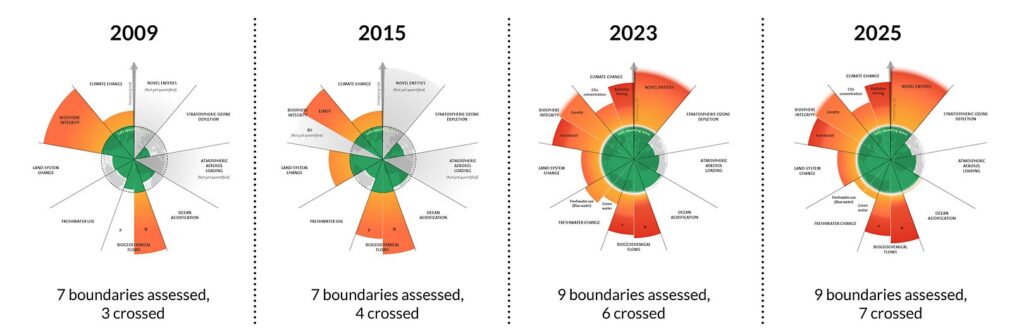
Planetary boundaries define the safe environmental limits within which humanity can operate to avoid destabilizing the Earth’s life-support systems.
Climate Change: The overarching boundary tracking greenhouse gas concentrations and global temperature rise.
Biosphere Integrity: Relates to the loss of biodiversity and the extinction of species, affecting overall ecosystem health.
Stratospheric Ozone Depletion: The thinning of the ozone layer, which protects the Earth from harmful UV radiation.
Ocean Acidification: The lowering of ocean pH levels caused by the absorption of excess carbon dioxide, threatening marine life.
Biogeochemical Flows: The disruption of natural cycles, particularly the overloading of nitrogen and phosphorus (often from agricultural fertilizers).
Land-System Change: The alteration of the Earth’s land surface, primarily through deforestation and the conversion of natural habitats for agriculture or urban use.
Freshwater Use: The global consumption and extraction of water from lakes, rivers, and groundwater.
Introduction of Novel Entities: The release of synthetic chemicals, heavy metals, microplastics, and genetically modified materials into the environment.
Atmospheric Aerosol Loading: The emission of microscopic particles and air pollutants that affect cloud formation, precipitation, and the climate
Several of these boundaries have already been crossed, including:
- Climate change
- Biodiversity loss
- Land-system change
- Biogeochemical flows
- Novel entities (chemical pollution)
Crossing these limits increases the risk of irreversible environmental change.
Organizations, Systems, Science and People Working
Global Governance & International Agreements
These create the rules, goals, and coordination mechanisms for countries.
Climate
- Paris Agreement
- Kyoto Protocol
- United Nations Framework Convention on Climate Change (UNFCCC)
Biodiversity
- Convention on Biological Diversity
- Kunming-Montreal Global Biodiversity Framework
Sustainable Development
- United Nations Sustainable Development Goals (SDGs)
Ozone Protection
- Montreal Protocol
Scientific Bodies
These organizations tell the world what is happening.
Climate
- Intergovernmental Panel on Climate Change
Biodiversity
- Intergovernmental Science-Policy Platform on Biodiversity and Ecosystem Services
Earth Observation
- National Aeronautics and Space Administration
- National Oceanic and Atmospheric Administration
- European Space Agency
United Nations Environmental Agencies
Key Organizations
- United Nations Environment Programme
- Food and Agriculture Organization
- United Nations Development Programme
- World Meteorological Organization
Their work includes:
- Climate policy
- Biodiversity conservation
- Sustainable agriculture
- Environmental monitoring
- Capacity building
Major Environmental NGOs
Conservation
- World Wide Fund for Nature
- Conservation International
- The Nature Conservancy
Advocacy
- Greenpeace
- Friends of the Earth
Research
- World Resources Institute
- Stockholm Environment Institute
Environmental Concepts Guiding Action
These ideas shape environmental thinking.
Planetary Systems
- Planetary Boundaries
- Earth System Science
Economics
- Circular Economy
- Green Economy
- Doughnut Economics
Ecology
- Ecosystem Services
- Nature-based Solutions
Major Global Initiatives
Climate
- Net Zero Movement
- Carbon Neutrality Programs
- Climate Adaptation Programs
- Climate Resilience Planning
Nature
- 30×30 Initiative (protecting 30% of land and oceans by 2030)
- Global Reforestation Programs
- Mangrove Restoration Programs
Finance
- ESG Investing
- Sustainable Finance
- Green Bonds
- Climate Risk Disclosure
Technologies Fighting Environmental Problems
Energy
- Solar Power
- Wind Power
- Hydropower
- Geothermal Energy
- Green Hydrogen
Transportation
- Electric Vehicles
- Public Transit Electrification
- Sustainable Aviation Fuels
Industry
- Carbon Capture and Storage (CCS)
- Green Steel
- Low-Carbon Cement
Agriculture
- Precision Agriculture
- Vertical Farming
- Regenerative Agriculture
- Soil Carbon Monitoring
Monitoring
- Satellite Monitoring
- AI Environmental Modelling
- Remote Sensing
- Smart Grids
Governments and Regulatory Systems
Every country has environmental governance structures.
United States
- Environmental Protection Agency
Europe
- European Commission Green Deal
India
- Ministry of Environment, Forest and Climate Change
- Central Pollution Control Board
Global Financial Institutions
- World Bank
- Global Environment Facility
- Green Climate Fund
Influential Environmental Thinkers & Leaders
Science
- James Hansen
- Johan Rockström
- Rachel Carson
Conservation
- Jane Goodall
- David Attenborough
Climate Activism
- Greta Thunberg
- Vandana Shiva
Why Have These Efforts Fallen Short?
Despite decades of environmental action, many indicators continue to worsen.
Collective Action Problems
Environmental issues require cooperation across nations, industries, and communities. However, countries often fear losing economic competitiveness if they act alone.
Political Short-Termism
Political leaders typically operate within election cycles lasting only a few years. Environmental challenges require planning over decades.
Corporate Incentives
Many businesses remain rewarded for maximizing short-term profits rather than long-term ecological sustainability.
Human behaviour
Scientific knowledge alone rarely changes behaviour. People may understand environmental problems yet continue unsustainable habits due to convenience, social norms, or economic pressures.
Scale of Consumption
Efficiency improvements often fail to offset rising consumption. As economies grow, total resource use frequently increases despite technological gains.
Profit-minded individuals and organizations
Businesses and influential individuals were threatened by the possibility of losing their market share to competitors offering greenwashed or slightly more sustainable alternatives. As a result, friction between these groups gave rise to numerous social debates and controversies, which often discouraged people from supporting environmental initiatives. Some traditional institutions also ended up working against environmental causes indirectly.
What Needs to Be Done?
The environmental crisis cannot be solved through a single technology, policy, or organization. It requires transformation at multiple levels. Governments and businesses are working on clean energy, circular economy, natural agricultural, resource management, ecology protection and conservation. Its still not enough, people should be
Redefining Progress, Societies must move beyond measuring success solely through economic output. Indicators should include:
- Ecological health
- Human well-being
- Social resilience
- Long-term sustainability
Educated and have Cultural Change, Environmental literacy should become a fundamental component of education. Every person on earth must understand:
- Long-term consequences of loss of ecological systems
- Technology won’t solve environmental crisis, it can only help.
- Its ours responsibility.
- That crisis is true, its not a exaggeration and should not fall for anti- environmental propaganda nor pro-exaggerated propaganda.
Addressing Human Psychology, Policies should recognize human behaviour rather than assume perfect rationality. Successful strategies should include:
- Social norms
- Incentives
- Behavioural nudges
- Community engagement
People are more likely to adopt sustainable behaviour when it becomes
- convenient,
- affordable, and
- socially accepted
- and genuine
Governments also prefer alternatives rather than economic sacrifices.
People should hold governments and businesses accountable for long-term environmental goals.